Essential Fats, Good Fats, Bad Fats for Dogs and Cats
Fat is one of the most misunderstood parts of a pet's diet. Owners scrutinise protein percentages but never once look at the fat source and quality. Fat is not just fuel. Fat shapes everything from coat condition to inflammatory disease risk.
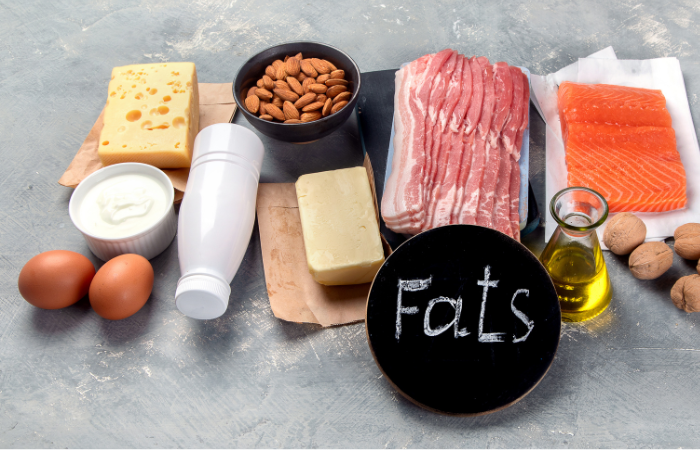
Essential fatty acids, food sources
Why fat matters beyond energy
Dietary fat is the most calorie-dense nutrient at roughly 9 kcal/g, more than twice the energy density of protein or carbohydrate. But its role goes well beyond fuel. Fat enables absorption of the fat-soluble vitamins (A, D, E, K), forms the structural backbone of every cell membrane in the body, supports skin barrier integrity and coat quality, aids growth and development, and serves as the raw material for eicosanoids, the signalling molecules (prostaglandins, leukotrienes) that regulate inflammation throughout the body.
The essential fatty acids: where dogs and cats actually differ
Linoleic acid (LA, omega-6) is essential for both dogs and cats. Neither species can synthesise it, so it must come from the diet. LA is a core structural component of the skin's lipid barrier and is required at every life stage in both species.
Arachidonic acid (AA, omega-6) is where the species split begins. Dogs can convert LA into AA via an enzyme called delta-6-desaturase, so AA isn't classified as essential for adult dog maintenance (though the NRC does set a minimum AA requirement for growing puppies, since conversion capacity in early life is limited). Cats, by contrast, have minimal to no delta-6-desaturase activity, even when fed diets high in LA, cats cannot reliably maintain adequate AA levels in plasma and tissue. AA has to come preformed from animal tissue, since plants don't contain it. This is one of the clearest biochemical reasons cats are obligate carnivores.
Alpha-linolenic acid (ALA, omega-3) is the fact worth correcting carefully, because it's easy to get backwards: ALA is essential for dogs at both growth and adult maintenance — but is only established as essential for cats during growth, not adult maintenance. Per NRC (2006) nutrient requirement tables, dogs have a minimum ALA requirement of roughly 0.044% (adult) and 0.08% (growth) of diet on a dry matter basis. Cats have a growth requirement (~0.02%) but no established adult maintenance requirement for ALA at all. AAFCO and FEDIAF guidelines broadly mirror this pattern.
EPA and DHA (the long-chain omega-3s) are where both species converge again: NRC lists minimum requirements for EPA+DHA across all life stages for both dogs and cats, because neither species converts ALA to EPA/DHA efficiently enough to rely on that pathway alone.
Essential Fatty Acids - Summary Table

Table listing the essential fatty acids for dogs and cats
What happens with deficiency
Fatty acid deficiency shows up primarily through the skin and coat in both species; the fastest-turnover tissue reliant on these fats:
Dry, dull, flaky coat (or in cats, sometimes a greasy, unkempt appearance)
Excessive shedding, or a coat that won't regrow properly after clipping
Slower wound healing
Increased susceptibility to skin infections, as a compromised barrier lets opportunistic bacteria and yeast in more easily
In prolonged deficiency: reduced growth in puppies and kittens, impaired reproductive performance
In cats specifically, since AA is also a precursor to thromboxane A₂ (a key platelet activator), AA deficiency can affect normal blood clotting
Omega-3 deficiency in particular has been associated with neurologic effects, including reduced visual acuity, most notably during development
These signs overlap heavily with allergies, hypothyroidism, and other skin conditions, so a persistent dull coat or recurrent infections is worth a full diet and veterinary review rather than an assumption either way.
Fats to avoid
Rancid or oxidised fats. Fat in kibble oxidises over time, especially once a bag is opened and exposed to air, heat, and light. Oxidation doesn't just reduce nutritional value. It generates free radicals and depletes vitamin E, since vitamin E is consumed as an antioxidant defending polyunsaturated fats from peroxidation. Diets high in PUFAs (including well-intentioned omega-3-fortified diets) actually increase the dietary vitamin E requirement for this reason. Signs of rancidity include an off, "paint-like" smell and reduced palatability.
Vague "animal fat" sourcing. Ingredient lists that just say "animal fat" without naming the source can vary significantly batch to batch. Named sources (chicken fat, salmon oil) are more predictable and checkable.
Fried or fatty table scraps. Dogs are sensitive to a sudden high-fat load as a trigger for pancreatitis.
Hidden fat in treats. Many commercial treats carry a disproportionate fat load relative to size, and this rarely gets factored into a pet's total daily fat intake.
Why plant-based omega-3 (ALA) isn't a reliable supplement choice for either species
This is one of the most common questions in consults: "Can't I just use flaxseed oil instead of fish oil?"
The biochemistry is clear on this: dogs and cats convert dietary ALA into the biologically active long-chain forms — EPA and DHA — very inefficiently. Published estimates put ALA-to-EPA/DHA conversion at under 10%. If the goal is a specific, measurable omega-3 benefit — skin and coat support, joint comfort, cardiovascular or cognitive support — a marine-derived source (fish oil) or algal oil delivers EPA and DHA directly, without relying on that inefficient conversion step.
It's worth noting this doesn't make ALA itself unimportant. Emerging research also suggests ALA has independent anti-inflammatory signalling effects (via activation of a receptor called GPR120) separate from its role as an EPA/DHA precursor. So the correct framing isn't "ALA is useless" — it's "ALA and EPA/DHA are not interchangeable, and a product relying solely on flaxseed to deliver omega-3 benefit won't get you the EPA/DHA-driven effects."
Good sources of fat for dogs and cats
Animal tissue — the only real source of preformed AA that cats require
Fish oil (salmon, sardine, anchovy, herring, menhaden) — direct EPA and DHA
Algal oil — a non-fish, more environmentally sustainable source of EPA/DHA; increasingly used as fish stock sustainability becomes a bigger industry concern
Flaxseed or camelina oil — valid ALA sources, particularly relevant for meeting a dog's ALA requirement, but not a substitute for EPA/DHA sources
How to select and dose an omega-3 supplement
Check for explicit EPA and DHA content per serving — not a vague "fish oil" or "omega-3" total.
Confirm third-party testing for purity (heavy metals, PCBs) and oxidation status.
Use species- and weight-appropriate dosing. Published clinical dosing ranges for EPA+DHA (combined) commonly cited in veterinary nutrition literature run roughly 50–75 mg/kg body weight for dogs and 30–50 mg/kg for catsfor general supplementation, with higher therapeutic ranges (up to ~50–220 mg/kg depending on condition) used under veterinary guidance for specific disease management. Don't scale a dog product down "by eye" for a cat!
Know the upper limit and the gap in the data. NRC has published a safe upper limit for dogs of 2,800 mg EPA+DHA per 1,000 kcal of diet (about 370 mg/kg⁰·⁷⁵). No safe upper limit has been established for cats at any life stage, which is exactly why more caution is warranted when dosing cats, especially at the higher end of any range.
Choose opaque, airtight packaging — fish oil oxidises quickly once opened.
Check for adequate vitamin E, either in the supplement or the base diet, since higher PUFA intake increases the vitamin E requirement.
If your pet's diet already contains added omega-3 (many joint, skin, or renal support diets do), recalculate before adding a separate supplement on top. Stacking two sources without accounting for total intake is a common way owners inadvertently over-supplement.
A note on over-supplementation
More is not automatically better. Documented dose-dependent adverse effects of omega-3 over-supplementation include GI upset (vomiting, diarrhea), altered platelet function (relevant before surgery or in pets with clotting concerns), and at very high doses in specific contexts — short-term effects on wound healing. These effects are generally dose-dependent and become more relevant at the higher end of therapeutic dosing ranges, not typical maintenance-level supplementation. Working from your vet's guidance on dose, especially for cats where no safe upper limit exists, is the safest approach.
Frequently Asked Questions
Q: Is fish oil safe for both dogs and cats?
A: Generally yes at an appropriate dose, but pets on blood-thinning medication, with clotting disorders, or scheduled for surgery should only use fish oil under veterinary guidance.
Q: Can too much good fat still be a problem?
A: Yes! Excess fat of any quality contributes to weight gain and, in susceptible dogs and cats, raises pancreatitis risk. Fat quality and fat quantity are separate considerations.
Q: Do I need to worry about my dog's ALA intake specifically?
A: It's worth knowing that ALA has an established minimum requirement for dogs at every life stage - unlike cats, where it's only required during growth. A diet built primarily around fish oil (EPA/DHA) without any plant-based ALA source could theoretically leave a gap in a dog's ALA intake specifically, though most commercial diets include enough plant oil to cover this.
Q: Can cats be fed a diet formulated for dogs, or vice versa?
A: No, as the AA requirement for cats at every life stage, alongside the species differences in ALA requirements outlined here, are among several reasons dog and cat diets aren't interchangeable.
Written by Katherine Khoo, certified pet nutritionist (Small Animal Natural Nutrition, CIVT Australia) and founder of Wisetroop, with 12+ years of nutrition experience across both human and animal health. This article is for educational purposes and does not constitute veterinary medical advice. Always consult your veterinarian before making significant changes to your pet's diet or supplementation.